- Client industry
- Automation equipment
- Part
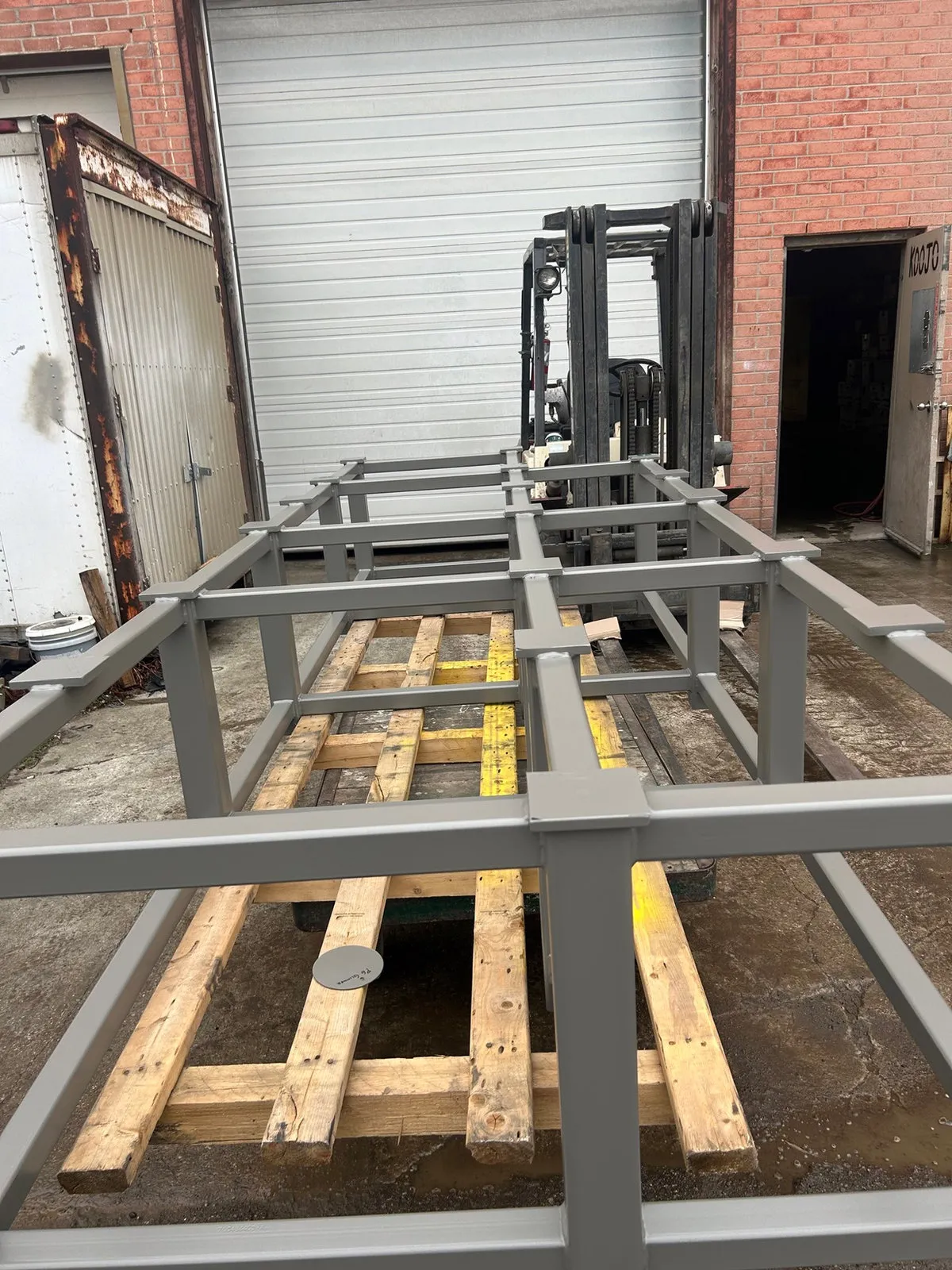
- Machine frame for an automation line
Automation line frame case study: this page explains how Koojo Custom Powder Coating finished a welded machine frame that carries robots, sensors and tooling on an automated assembly line. Since 2012 our Milton shop at 10874 Steeles Ave E has finished more than 10,000 items, much of it for machine builders, integrators and manufacturers.
Frames on an automated line hold equipment that must stay aligned and electrically sound, so the coating has to protect the steel without getting in the way of mounting or grounding. Read on for what made this frame for an automation line difficult, how we handled each stage, what the client received and the specs behind it. Most standard jobs are ready in 48 hours, and drop-offs are taken weekdays between 7 AM and 5 PM. Figures quoted on this page are taken from the shop's own job records and photographs. An automation integrator or plant engineer can use it to check whether our process suits their own lines.
Project Snapshot
Item | This job |
|---|---|
Client industry | Manufacturing and automation |
Part | Welded machine frame for an automated assembly line |
Metal | Structural steel tube & plate weldment |
Size / Weight | 14 ft L x 5 ft W x 6 ft H / Approx. 2,200 lb |
Powder | High-durability TGIC polyester (Tiger Drylac) |
Colour Code | RAL 7035 Light Grey / Machine Builder Standard |
Turnaround | 48 hours (standard orders: 48 hr) |
The Challenge
The challenge was to coat an automation line frame so it resists factory floor wear while its mounting plates, tapped holes and grounding points stay bare, flat and ready for equipment to bolt on without any rework at line commissioning.
That is why this automation line frame case study begins with what had to stay uncoated rather than with the colour.
An automated cell is only as accurate as the frame under it. Robots, vision sensors and fixtures bolt onto flat mounting plates, and any coating left on those faces can throw alignment off or stop a bracket from seating. Tight tolerance holes have the same problem, because powder in a thread or a dowel bore means drilling or tapping on site.
Electrical continuity added another layer. Automation equipment needs a clean path to ground, and a coated contact point breaks it. Grounding point masking therefore had to be planned on the drawing, not left to the person spraying. Getting that wrong on one frame would mean a call from the integrator during start-up, which is the risk this automation frame case study sets out to avoid.
Appearance mattered too. Machine builder frames are often built as modular frame sections that sit side by side, so every piece had to match the client's equipment colour standard. Batch colour consistency across the sections was part of the brief, along with a production schedule that left little slack for this automation line frame project.
Our Approach
Our approach in this automation line frame case study ran in three stages: masking and surface prep, an even electrostatic coat, and a cure followed by checks of every bare surface. The masking plan came first, because the bare surfaces decided how the rest of the job was run.
Preparation
We marked every mounting plate, tapped hole and grounding point on the drawing with the client before work began. Media blasting cleaned the welds and removed scale so the powder had a sound surface to bond to, and chemical pretreatment followed to improve adhesion and corrosion resistance. The frame was rinsed and dried fully before masking. On precision frames, masking often takes longer than spraying itself. Welds were also checked for porosity before blasting, since trapped air can cause pinholes during cure. Heat-resistant plugs filled the tight tolerance holes, and high-temperature tape covered the sensor mounting surfaces and ground pads. Careful prep is what turns an automation line frame into an install-ready frame.
Application
Electrostatic spraying carried the powder around tube corners and into gussets, giving weld seam coverage and edge coverage without heavy build on the flat faces. We set hang points away from visible surfaces and turned the frame during spraying so every side received the same film. Spray settings stayed the same for every section of the frame for an automation line, which keeps gloss and texture matched. Film build uniformity matters on modular frames, because a thicker coat on one section can show as a colour or gloss shift beside its neighbour on this automation line frame project.
Curing & Inspection
Curing ran at 180–200 °C on the thermoset powder supplier's oven cure cycle, in an oven rated for parts up to 6,000 lb. After cooling, we removed the masking and checked every bare surface for clean edges, with the drawing in hand so nothing was missed. Film thickness readings were taken to ASTM D7091 and adhesion testing was done to ASTM D3359, and the results sit in the job file. Those records keep this automation line frame case study traceable. Our usual 48 hour turnaround applies to standard work; the snapshot shows how long the automation line frame actually took.
The Result
The result was a powder coated machine frame with a smooth industrial finish, clean mounting plates and grounding points, open threads and recorded test readings, ready for the integrator to fit equipment as soon as the automation line frame arrived.
Because the masked areas stayed bare, robots and sensors could be bolted down and grounded without scraping or re-tapping. Even film build kept the frame square to the drawing, and the matched colour let it sit beside other sections without a visible change. That saves time at line commissioning, which is often the tightest part of an automation schedule.
The coating also protects the frame from the knocks, coolant splash and cleaning it will see over years of service. This automation frame case study shows the standard we bring to all automation equipment frame coating, whether the order is one frame or multi-frame orders for a full line. Maintenance teams also get a record of the powder and colour code, so a replacement section for the automation line frame can be matched later.
If you are comparing coaters for manufacturing automation equipment, use this automation line frame case study as a checklist. Ask how they mask ground points, how they protect threads and how they keep colour matched across sections. The answers will tell you whether the frame will arrive ready to install or ready for rework.
Specs at a Glance
Here are the key numbers from this automation line frame project, covering film thickness, preparation grade, powder and cure. Hold them up against your own frame drawings before you ask us for a price.
Spec | Value |
|---|---|
DFT (dry film thickness) | 3.0–4.5 mils, measured to ASTM D7091 |
Prep grade | SSPC-SP 10 Near-White Blast & Iron Phosphate |
Powder | TGIC Polyester, Tiger Drylac Series 49, RAL 7035 |
Cure | 180–200 °C metal temperature for 15 minutes |
Certification from the Absolute Bureau of Certification covers our quality system, and the powder coating quality assurance page explains each check; test reports can be supplied with the order. For bigger assemblies, see large part powder coating, which handles up to 6,000 lb. Every specification for the automation line frame comes directly from our shop job record. Readings are taken on edges and welds as well as flat faces.
Services Used
Three Koojo services came together as one process on this automation line frame project: surface preparation, industrial powder coating and custom powder coating colours. Each linked page below explains a service for buyers planning a similar assembly cell frame or production line.
Industrial powder coating is the core process for machine frames of this kind, while powder coating surface preparation deals with pretreatment, masking and plugging. Custom powder coating colours handle matching to an equipment standard across every section. It also shows powder coating for manufacturers at work: a single shop taking a frame for an automation line from bare steel to inspected finish. With no hand-offs between vendors, nobody else has to learn the masking plan.
Have a Similar Part?
Share your frame drawings, photos and quantities, and quote this automation line frame case study so we can reuse the same masking plan. Phone (905) 876-7060 on weekdays between 7 AM and 5 PM, or use our online powder coating quote form.
We confirm masking, powder and timing in writing before any work starts, and more examples sit on our powder coating projects page.