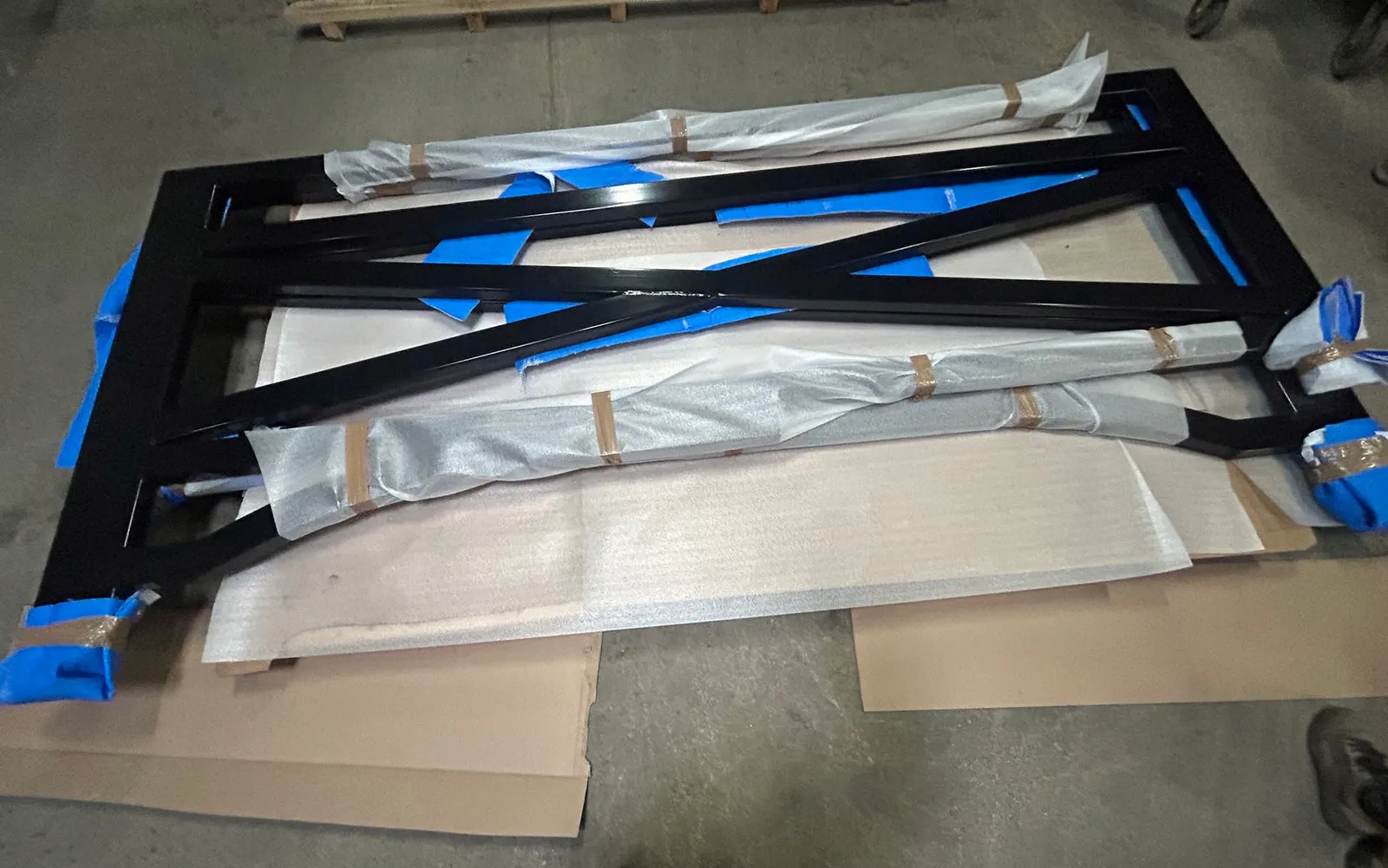
- Client industry
- Religious institution
- Part
- Decorative steel gates
Church gates case study: a pair of ornamental gates came to our shop with decorative scrollwork, finials and decades of weather on them, and this page records how we brought them back. Koojo Custom Powder Coating has been coating metal in Milton, at 10874 Steeles Ave E, since 2012, with more than 10,000 items finished for churches, schools, contractors and other clients.
Gates like these greet every visitor, so they need to look right as well as last. Below, you can follow the brief, the steps we took, how the gates for a church turned out, the technical figures and the services involved. On standard work our turnaround is 48 hours, and parts can be brought in on weekdays during shop hours, 7 AM through 5 PM. The facts on this page are drawn from our job record and photographs, so a facilities committee or contractor can judge the result with confidence. Every gate we restore gets the same attention, whether it is new steel or a century-old casting.
Project Snapshot
Item | This job |
|---|---|
Client industry | Institutional (church) |
Part | Ornamental gate leaves (pair, 8 ft x 6 ft each) and posts |
Metal | Wrought iron and carbon steel |
Size / Weight | Two 8 ft x 6 ft leaves plus posts / Approx. 450 lb total |
Powder | Architectural polyester (Prismatic / Tiger Drylac) |
Colour Code | Satin Black (RAL 9005) |
Turnaround | 48 hours (standard orders: 48 hr) |
The Challenge
The task was to restore weathered metalwork with fine, curved detail: strip years of old paint and rust, reach deep into every scroll and joint with fresh powder, keep the hinges and latches working, and return a traditional look that suits the building.
Old church gates usually carry several layers of paint, each one applied over the last whenever the metal started to show rust. Those layers crack, trap moisture and hide rust pitting underneath. Simply painting over them again would only restart the repaint cycle, with flaking back within a few seasons. Each layer added to the problem rather than solving it, and the gate leaves on these church gates were no exception.
Shape added the real difficulty. Decorative scrollwork, pickets and finials create recessed corners and tight gaps where powder struggles to reach, a problem known as the faraday cage effect. Without care, the outer curves get a heavy coat while the inside of each scroll gets almost none, and that is where rust returns first. For this church gates case study, fine detail coverage was the main test.
Function and appearance also mattered. Hinges, latch hardware and any moving parts had to swing freely after coating, and the finish had to respect the heritage appearance of the church grounds. The client also wanted a short gap between gate removal and reinstallation, so the church gates project had to keep moving through each stage.
Our Approach
In this church gates case study the work followed three steps: strip and clean the metal back to bare steel, build the powder into every recess with careful spraying, then cure and inspect each leaf in good light before the gates went back to the church.
Preparation
Old paint removal came first. Layers that blasting alone would struggle with were stripped, and abrasive blasting then took the gates down to bare metal cleaning standard, opening up any rust pitting so it could be treated rather than hidden. We looked closely at every weld and scroll on the gates for a church for cracks or thin metal and flagged anything that needed repair before coating. Stripping also showed exactly how much original metal remained. A chemical pretreatment came next, followed by a rinse and a thorough dry. Hinge masking and masking moving parts finished the prep, so pins and latches would turn freely once the church gates were rehung.
Application
Detailed metalwork needs a different spray technique from flat panels. We lowered the gun settings and worked into the scrolls first, letting the powder settle into recessed corners before coating the outer faces, which beats the faraday cage effect without piling up film on the edges. Colour sample approval came before spraying: the client chose a satin black finish, a low gloss finish that reads as traditional ironwork. Each leaf of the church gates was hung so contact marks would sit on hidden edges, and the gate posts were coated in the same batch so the set matches.
Curing & Inspection
The leaves cured at 180–200 °C to the powder supplier's schedule, in an oven that takes pieces up to 6,000 lb. When they had cooled, we checked inside scrolls and behind pickets with a light, where thin spots would hide, then measured thickness to ASTM D7091 and adhesion to ASTM D3359, logging every reading for the church gates project. Masking came off last, and each hinge and latch was worked by hand to confirm free movement. Work like this usually fits our 48 hour standard, and the snapshot notes how long this church gates case study actually took.
The Result
The church received its ornamental gates back with a smooth, even finish deep inside every scroll and joint, hinges and latches that swing freely, a colour that suits the building, and test readings on file for the parish property records.
Because the coating on these church gates reaches the recesses as well as the outer faces, there are no thin spots waiting to rust through. That breaks the cycle of scraping and repainting that older wrought iron gates often fall into, and it gives the church outdoor durability measured in years rather than seasons. Maintenance drops to an occasional wash.
Visually, the low sheen hides small marks and keeps the gates close to the look of traditional ironwork. Visitors see clean, crisp detail on the finials and pickets instead of drips or heavy edges. The same restoration coating approach suits any church gates with fine detail, from a single garden gate to a full set of entrance leaves and posts. That is the standard we hold every church gates project to.
If your church or school is weighing up repainting against powder coating, this church gates case study is a fair guide to what to ask. Find out how the coater will remove old paint, how they will reach inside the scrollwork and how they will protect the hinges. The answers usually separate a lasting finish from another short repaint.
Specs at a Glance
Four details sum up the technical side of this church gates project: film thickness, prep grade, powder type and cure. Committees and contractors can share them with an architect or heritage adviser before deciding on their own gates.
Spec | Value |
|---|---|
DFT (dry film thickness) | 3.5–5.0 mils, measured to ASTM D7091 |
Prep grade | Thermal stripping & fine garnet abrasive blast |
Powder | Architectural Polyester, Satin Black, RAL 9005 |
Cure | 180–200 °C metal temperature for 15 minutes |
Koojo's quality system holds certification from the Absolute Bureau of Certification, with the steps set out under powder coating quality assurance; a copy of the test report can go to the church on request. Larger gate sets are no problem, as large part powder coating covers items up to 6,000 lb. Entries for the church gates were taken directly from our shop job record.
Services Used
Restoring these gates for a church drew on three Koojo services in a single process: stripping and recoating, architectural powder coating and custom powder coating colours. Each service has its own page, linked below, for churches, schools and contractors planning similar work.
Powder coat stripping and recoating handles the removal of old finishes and rust before new powder goes on. Architectural powder coating covers gates, railings and other outdoor metalwork, and custom powder coating colours took care of the satin black and colour sample. The project also sits within powder coating for municipalities, which includes churches and other institutions with public-facing metalwork, so the church gates followed the same standards we apply to civic jobs.
Have a Similar Part?
If your gates need the same care, send a few photos with rough sizes and mention this church gates case study so we know the detail involved. Speak to us on (905) 876-7060, 7 AM to 5 PM weekdays, or begin a powder coating quote online.
We will agree the prep, colour and timing with you first, and our powder coating projects page shows more completed work.