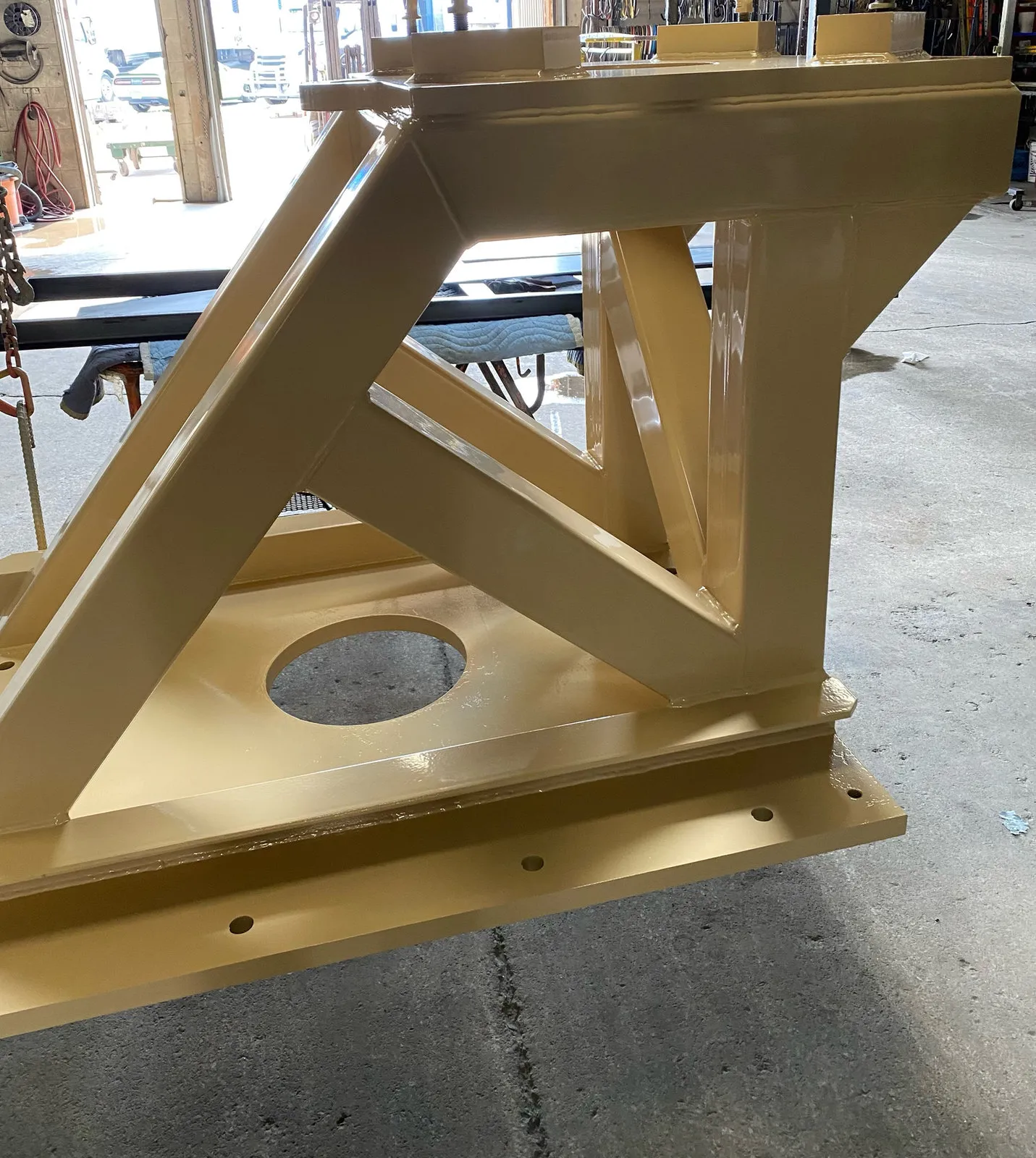
- Client industry
- Manufacturing
- Part
- Robot base / pedestal
Robotic base case study: the following account covers how our team finished a heavy welded pedestal that lifts and anchors an industrial robot inside a manufacturing cell. Our team at 10874 Steeles Ave E in Milton has coated over 10,000 items since 2012, with manufacturers, machine builders and integrators making up a large share of that work.
A robot pedestal carries the full weight and motion of the arm, so its coating has to take knocks and vibration while leaving every mounting face clean. From here, the page moves through the brief, the method, the finished part, the data and the services behind this base for an industrial robot. Regular orders leave within 48 hours, and parts can be dropped off any weekday from 7 AM until 5 PM. All data here is drawn from our records and pictures of the actual part, giving engineers and buyers something concrete to check before a drawing changes hands. An integrator can use it to judge whether our process suits their own cells.
Project Snapshot
Item | This job |
|---|---|
Client industry | Manufacturing and automation |
Part | Welded robot pedestal / riser for a robotic cell |
Metal | Heavy structural steel plate and heavy tube weldment |
Size / Weight | 5 ft H x 3 ft W x 3 ft D / Approx. 1,800 lb |
Powder | High-durability thermoset polyester / epoxy hybrid |
Colour Code | Industrial Machine Grey (RAL 7035 / Cell Spec) |
Turnaround | 48 hours (standard orders: 48 hr) |
The Challenge
The challenge was to put a durable industrial coating on a heavy robotic base while keeping the machined top plate, the bolt pattern and the anchor bolt holes completely bare, so the robot and the floor fixings would seat exactly as designed.
A floor-mounted robot transfers its dynamic loads straight into the pedestal below it. Every fast move of the arm flexes and shakes the steel, and any coating trapped under the robot flange can creep or crack over time. That is why the top mounting plate needs true metal-to-metal contact, with no powder between the robot and the steel. Every one of those features on the robotic base had a job to do once the cell was running.
The underside brought the same issue. Levelling pads and anchor bolts set the base square to the floor, and powder in those holes would mean drilling or grinding on site during robot installation. Cable pass-through openings also had to stay clean so grommets would fit. Planning those details first is why this robotic base case study opens with what had to stay uncoated.
Then there was the mass. Thick steel sections heat slowly in an oven, so a base like this cannot simply share a cycle with thin sheet parts. It also had to survive forklift handling in the plant and arrive for the integrator's delivery date, which left little room for error on this robotic base project.
Our Approach
Our approach in this robotic base case study followed three steps: blast and mask the heavy steel, spray a uniform coat, then bring the whole mass up to its true part temperature and test the result. The masking plan and the cure plan were fixed before any blasting started.
Preparation
We marked the machined top plate, the bolt pattern, the anchor holes on the robotic base and the cable openings on the drawing with the client. Abrasive blasting took mill scale and weld spatter off the heavy plate steel, giving the powder a rough, clean profile to key into. After a chemical pretreatment, the base was rinsed and left to dry completely. Thread protection came next: heat-resistant plugs went into every tapped hole and high-temperature tape covered the mounting faces. Welds on thick plate can hold air, so preheating was used, where needed, to drive off any outgassing before powder went on.
Application
Electrostatic spraying carried the powder over gussets, welds and edges, the areas most exposed to bumps around a robotic cell. We hung the welded steel pedestal from points that would sit out of sight once installed, and turned it during spraying so every face of the robotic base received the same film. Hanging points were also checked so the pedestal could not swing into other parts while it was sprayed. Even coverage on the column and feet protects the base where carts and forklifts are most likely to strike it, and keeps the colour consistent with the cell colour scheme.
Curing & Inspection
Heavy parts are cured by part temperature, not just oven time. The robotic base stayed in our oven until the steel itself reached the 180–200 °C cure range set by the powder maker, which matters on thick sections that lag behind the air. Pieces weighing up to 6,000 lb fit in that oven. Once it had cooled, the tape and plugs came out and each mounting face was inspected. Cure verification included readings with a film thickness gauge to ASTM D7091 and a cross-cut adhesion test to ASTM D3359, all recorded against the job number. Those records keep this robotic base case study traceable. Typical orders are done in 48 hours, and the snapshot records the exact duration of this robotic base project.
The Result
The client got back a robot riser with strong impact resistance on the column and feet, a bare top plate ready for the robot flange, open anchor and tapped holes, and recorded test readings for the integrator's file.
Because the mounting faces on the robotic base stayed clean, the robot could be bolted down and torqued without scraping or re-tapping, and the base sat level on its pads. Full cure through the thick sections means the coating will not soften or mark under load, which protects the finish where the arm's movement is felt most. Clean seating also shortens commissioning, usually the tightest part of a robot project.
The finish also guards against corrosion from coolant, cleaning and the humidity of a working plant. This robotic base case study reflects the standard we bring to every heavy machine base, whether the order is a single pedestal or a run of matching pedestals for a new line. Careful packaging for transport protected the finished faces of the robotic base project on the way out.
If you are comparing coaters for your next base for an industrial robot, use this page as a checklist. Ask how they mask flange faces, how they cure thick steel and how they record readings. Those answers decide whether a pedestal arrives ready to install or ready for rework.
Specs at a Glance
Four numbers define this robotic base project, namely film thickness, prep grade, powder and cure. Compare them with your own pedestal drawings and load requirements before you ask us for a quote on similar equipment.
Spec | Value |
|---|---|
DFT (dry film thickness) | 3.5–5.0 mils, measured to ASTM D7091 |
Prep grade | SSPC-SP 10 Near-White Blast & Degreasing Pretreatment |
Powder | Thermoset Polyester/Epoxy Hybrid, RAL 7035 |
Cure | 180–200 °C part temperature per powder data sheet (20 min) |
We run a quality system certified by the Absolute Bureau of Certification, described on the powder coating quality assurance page, and copies of test reports are available to integrators who ask. Even heavier pedestals are possible, since large part powder coating at Koojo goes up to 6,000 lb. Every specification above comes directly from our shop job record. Gauge points included gussets and fillet welds, where thin film is most likely.
Services Used
Abrasive blasting, surface preparation and industrial coating were the three Koojo services joined into one process for this robotic base project. Manufacturers and integrators planning comparable equipment will find each service explained on the linked pages.
Industrial powder coating handles pedestals, frames and other heavy machinery. Sandblasting services remove scale and spatter from thick plate, and powder coating surface preparation covers pretreatment, plugging and masking. For plant owners, the project illustrates powder coating for manufacturers, with one team responsible for the base for an industrial robot from drawing review to dispatch. No second supplier ever touched the mounting faces, which is exactly how a masking plan stays intact.
Have a Similar Part?
Email drawings and photos of your pedestals with the quantity, and name this robotic base case study so we follow the same masking and cure plan. The fastest route is a powder coating quote request online; our phone, (905) 876-7060, is answered weekdays from 7 AM until 5 PM.
Before work begins, you get the prep, powder and schedule confirmed; meanwhile, browse other powder coating projects.