- Client industry
- Site protection
- Part
- Steel safety bollards
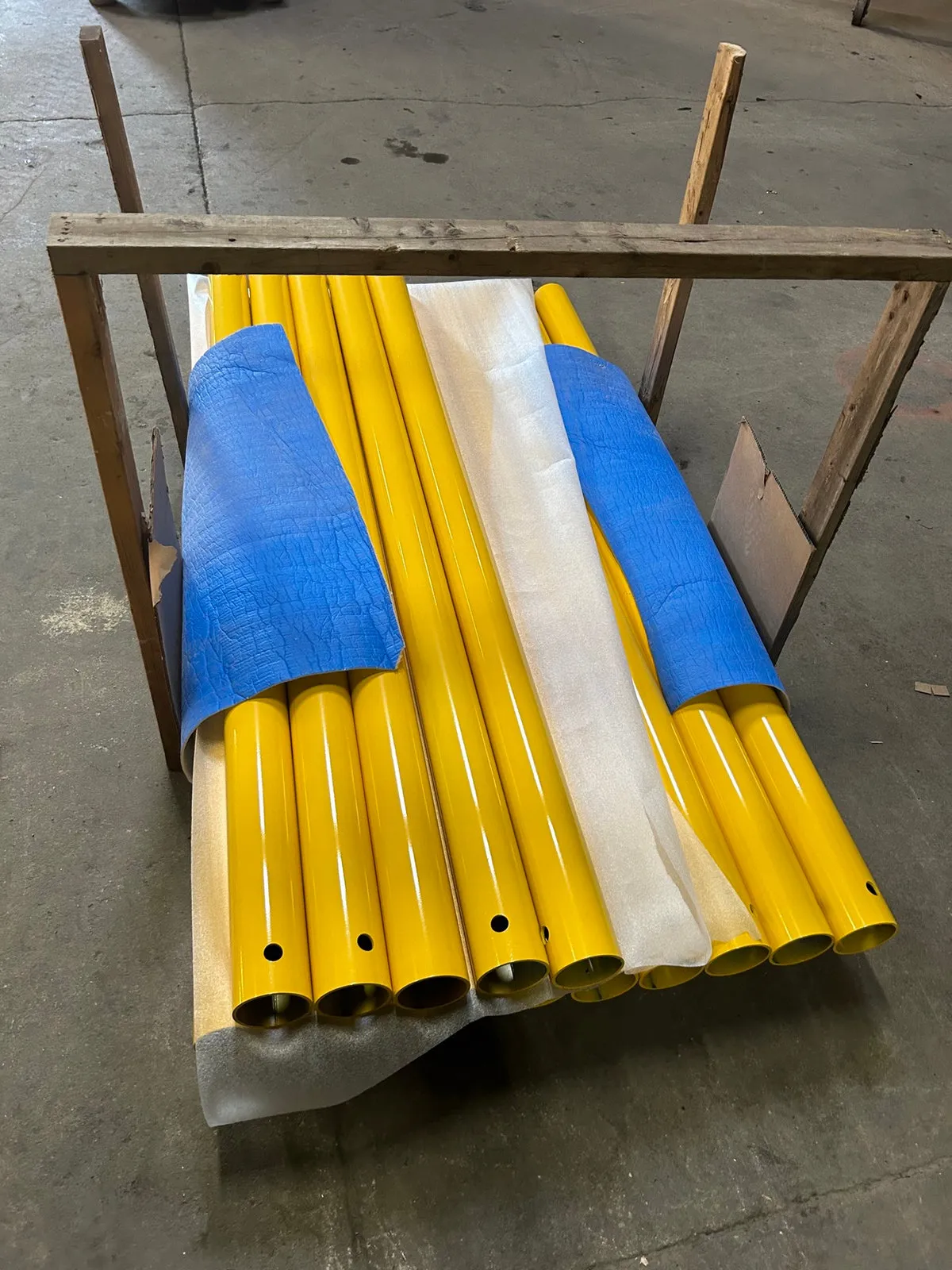
Bollard powder coating case study: here we document how our Milton shop blasted and coated a set of steel safety posts that protect people, storefronts and buildings from vehicles. From our facility at 10874 Steeles Ave E, we have finished upwards of 10,000 items since 2012 for contractors, property managers, municipalities and fabricators.
Bollards stand outside all year, so their finish has to survive sun, rain, road salt and the odd bumper without peeling or rusting. Further down you will find why this safety bollard order was demanding, how we prepared and coated each post, how it turned out and the figures on file. A standard job takes 48 hours from drop-off, and the shop accepts deliveries every weekday from 7 AM to 5 PM. Details on this page reflect our written records and photographs, so site owners and contractors can assess the job before sending a sample post or drawing. One shop handles every step from blasting to inspection.
Project Snapshot
Item | This job |
|---|---|
Client industry | Municipal and institutional |
Part | Steel safety bollards (run of 24 posts with base plates) |
Metal | Schedule 40 steel pipe with welded base plates & caps |
Size / Weight | 6 in diameter, 48 in height, approx. 70 lb each |
Powder | Super-durable exterior polyester (Tiger Drylac / AkzoNobel) |
Colour Code | OSHA Safety Yellow (RAL 1023) |
Turnaround | 48 hours (standard orders: 48 hr) |
The Challenge
The challenge was to give each safety bollard in the batch a high-visibility finish that stays bright under constant outdoor exposure, resists rust from road salt and survives knocks from vehicles, carts and snowplows for years without regular repainting.
Bollards work in one of the harshest settings a coating can face. Summer sun breaks down weak finishes and causes colour fade and chalking, while winter brings freeze-thaw cycles and salt spray from passing traffic. Once water gets under a chip, corrosion undercutting spreads beneath the coating and lifts it away from the steel. A safety bollard that turns rusty and dull also stops doing its job of being seen. Ontario sites see both extremes within the same year.
Impact is the other test. Vehicle impact from bumpers, shopping carts and snowplow damage all hit the same band near the top of each post, so the coating needs real toughness as well as weather resistance. Any weak point at the welds, the caps or the cut edges at the base would fail first. That is why this bollard powder coating case study begins with where the posts will stand.
Consistency mattered too. A row of posts outside a building is seen side by side, so every piece needed the same shade and gloss. The client also needed the posts back in time for site installation, so the schedule for this bollard powder coating project had to hold.
Our Approach
Our approach in this bollard powder coating case study was built around three steps: get the steel ready for years outdoors, spray a weather-rated powder, then cure and check each post before it went to site.
Preparation
We checked the drawing and the site specification with the client first, including the colour, the expected exposure and whether any posts were removable bollards with sleeves that had to stay uncoated. Abrasive blasting removed mill scale, rust and weld spatter from the steel pipe bollards and left a clean profile for the powder to grip. After chemical pretreatment and rinsing, each post was dried inside and out, including under the base plates. Posts with welded base plates need extra care at that joint, where water tends to collect. Drain holes were checked so water could not sit inside a post after installation. Where a project calls for extra corrosion protection, a zinc-rich primer can be added before the topcoat; whether this order used one is recorded in the specs. Careful prep is what keeps a safety bollard finish from lifting at the base.
Application
Powder choice comes first for outdoor work. For posts like these we use an outdoor polyester powder, a UV resistant powder type made to hold colour in direct sun, in the colour the client specified. Electrostatic spraying wrapped the powder around the pipe, over the welds and onto the bollard caps and base plates, with extra attention to cut edges. Each safety bollard hung from a point that would be hidden once installed, and the whole batch of matching bollards was sprayed with the same settings for a consistent colour match.
Curing & Inspection
The batch went through the oven together at 180–200 °C, timed to the manufacturer's data, and since the oven accepts loads up to 6,000 lb, long or heavy posts fit in one cycle. After cooling, each safety bollard was checked for full coverage and even colour. Thickness readings followed ASTM D7091, the adhesion test followed ASTM D3359, and both sets of numbers were filed with the order. Those records keep this bollard powder coating case study traceable. We quote 48 hours for standard work, and how long this bollard powder coating project took is noted in the snapshot.
The Result
The result was a set of safety bollards with a bright, even, weather-ready finish, full coverage over welds, caps and base plates, a consistent colour match across every post, and test readings on file, ready for site installation.
A low-maintenance finish like this cuts the cost of owning bollards. Instead of yearly scraping and repainting, the coating keeps rust out and stays visible through Ontario winters and summers. That matters for pedestrian protection, because a faded, rusty post is easy to miss at night or in snow. Each bollard powder coating project we finish is planned for that kind of service life.
The same standard applies to parking lot bollards, loading dock bollards and base plate bollards used for storefront protection. Many sites add reflective bands after coating, and a sound finish gives that tape a clean surface to hold. This safety bollard case study shows how we treat every post that stands in public spaces, from a single replacement to a full row.
If you manage sites with older posts, recoating old bollards is often faster and cheaper than replacing them. Use this bollard powder coating case study as a checklist when you compare coaters, and ask how they prepare the base, which powder they use outdoors and how they keep colour matched. Bring one sample post, and we will show you the finish we recommend.
Specs at a Glance
Below are the core figures for this bollard powder coating project, namely film thickness, preparation grade, powder and cure. Match them to your own site specification or tender documents before requesting a price.
Spec | Value |
|---|---|
DFT (dry film thickness) | 3.5–5.0 mils, measured to ASTM D7091 |
Prep grade | SSPC-SP 10 Near-White Blast & Zinc-Rich Primer |
Powder | Super-Durable Outdoor Polyester, OSHA Safety Yellow |
Cure | 180–200 °C per powder data sheet (15–20 min) |
Quality on every order is managed under a system certified by the Absolute Bureau of Certification; read about it under powder coating quality assurance, and request test reports for tender files if needed. Extra-long or heavy posts can be booked as large part powder coating, with a limit of 6,000 lb. Data for each safety bollard comes directly from our shop job record. Readings cover welds and edges as well as the pipe body.
Services Used
For this bollard powder coating project we joined three Koojo services, abrasive blasting, architectural coating and colour matching, into a single process. Site owners, contractors and public buyers can follow the links below to see how each service works.
Architectural powder coating covers bollards, railings, gates and other outdoor metal, and sandblasting services remove rust and scale before coating. Custom powder coating colours handle safety yellow and other site colours. For public buyers it demonstrates powder coating for municipalities, where posts must meet municipal specifications and look the same from one safety bollard to the next. A single shop also keeps the colour steady, since the same crew sprays every post.
Have a Similar Part?
Got posts to coat? Send sizes, quantity and a photo, and point to this bollard powder coating case study so we can repeat the prep and powder. Prefer to talk? Ring (905) 876-7060, Monday to Friday 7 AM–5 PM, or fill in a powder coating quote request.
Nothing goes into the booth until prep, powder and timing are agreed; see more powder coating projects.